
Powered By



There’s only one surgical treatment designed to improve central vision in people with late- or end-stage age-related macular degeneration (AMD), and it sounds like something straight out of science fiction. An implantable miniature telescope (IMT) sits inside the eye and magnifies what’s in front of you.
Although it can take a while to get used to, this device may help you read from a distance, recognize people’s faces, and get a more complete view of your surroundings.
Here’s what you should know about how this procedure works, why it isn’t commonly done, and what the future of IMTs might look like.
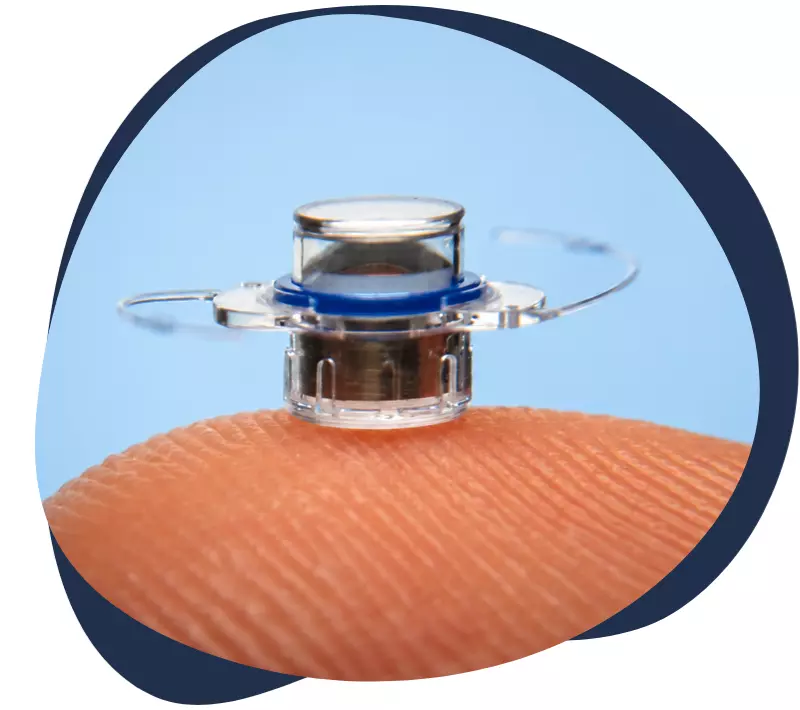
An implantable miniature telescope is a medical device that replaces your eye’s natural lens. It magnifies objects in your central vision around two to three times, then projects those larger images onto healthy parts of your retina around the damaged macula. The retina turns these images into signals that travel to the brain, allowing you to see the magnified view.
This process redirects images away from the damaged central part of the retina. The macula is the part of the retina responsible for central vision, which you use for tasks such as reading and recognizing faces.
When AMD damages the macula, you may develop blurry or missing areas in your central vision. Peripheral, or side, vision usually remains largely intact.
A telescope lens implant for macular degeneration changes how you use your peripheral vision. Because the device magnifies central vision, it reduces the field of view in the eye with the implant.
 This means the implanted eye is mainly used to see objects in the center of your field of view rather than objects off to the sides. Having a reduced field of view can make it harder to get around safely at first.
To help preserve peripheral vision, the miniature telescope is implanted in only one eye. You’ll use that eye mainly for detailed central vision and the other eye mainly for peripheral vision. Learning to use the two eyes this way takes practice and vision rehabilitation.
Telescope implant surgery is an outpatient procedure, which means you can usually go home the same day and don’t have to recover in a hospital. You’ll receive local anesthesia, so you’ll be awake but not feel pain during the procedure.
To start, the surgeon makes one or more small cuts around the eye and inserts small instruments to remove the eye’s natural lens. The pea-size telescope is then inserted through and carefully placed in the middle of the eye. The surgeon finishes by closing the incisions, often with stitches.
The original IMT was first approved by the U.S. Food and Drug Administration (FDA) in 2010. By 2022, an estimated 600 people had received the original IMT.
That’s a small number, considering nearly 1.5 million Americans have late-stage AMD. However, only some people with advanced AMD are candidates for an IMT. Strict eligibility criteria, potential risks and complications, and lengthy rehabilitation after surgery have limited its use.
 Strict Eligibility Criteria
There are strict eligibility criteria for an IMT device, so only some people with AMD qualify. The full list of requirements is complex. Some key criteria include:
An eye care provider can review the full list of eligibility criteria and contraindications (reasons the procedure may not be recommended) with you.
Potential ComplicationsTo implant the original IMT device, surgeons have to make a relatively large incision on the cornea (the clear front surface of the eye). This can change the shape of the cornea and cause surgically induced astigmatism. Astigmatism can cause blurry vision, difficulty seeing at night, headaches, and other problems.
The surgery also tends to damage about 1 in 4 corneal endothelial cells, which line the inside of the cornea and help keep it clear and healthy. Damaged endothelial cells can’t be replaced. IMT surgery may be especially risky for people who already have a low number of these cells.
Other complications are possible, such as inflammation and swelling. In rare cases, vision may get worse after IMT surgery.
Lengthy RehabSeeing with an IMT requires practice because the brain has to adapt to using magnified central vision from one eye and peripheral vision from the other. Until then, you may experience poor depth perception.
To improve vision after surgery, you’ll need vision rehabilitation. A low vision occupational therapist can guide you through exercises such as looking at moving objects while standing still or looking at stationary objects while walking. You’ll also practice using the implanted eye for central vision and the other eye for peripheral vision.
Researchers have developed a smaller device called the small-incision, new-generation (SING) IMT, which requires an incision about half the length of the one needed for the original IMT.
The SING IMT is folded into a narrow device that’s passed through the incision. Once the telescope is in the correct position, the eye surgeon releases it, and its arms unfold to hold it in place.
Early studies suggest the SING IMT may offer benefits beyond a smaller incision. For example, researchers are studying its benefit for people who already have an artificial lens from previous cataract surgery. Early research also suggests that the SING IMT procedure may cause less loss of corneal endothelial cells than the original IMT procedure.
Other differences include the following:
The SING IMT is available in many European countries, but it hasn’t been approved by the FDA.
Your retinal specialist is the best person to talk to about whether an IMT may be an option for you. They can examine your eyes and determine whether you meet the eligibility requirements for IMT surgery.
They may also refer you to a low vision specialist or an occupational therapist for practice sessions with an external telescope. This testing can help you and your care team understand how much magnification may improve your vision and what using an IMT could be like.
To qualify for an IMT, you’ll need to show enough improvement in your vision while using the external telescope. Your care team can explain what results are needed and whether an IMT is likely to help you.
Cost and insurance coverage can also play a role in your decision. Insurance coverage for an IMT varies by plan and may require prior authorization (approval from your insurance company before surgery).
An insurance plan may not cover the procedure if you don’t meet the eligibility requirements, which are often based on the FDA’s approved indications for the device.
If you’re considering an IMT, ask your eye care team and insurance company what costs are covered and what you may have to pay yourself. Costs can include the device, surgery, follow-up care, and vision rehabilitation.
 On myAMDteam, people share their experiences with age-related macular degeneration, get advice, and find support from others who understand.
Would you consider getting an IMT? Let others know in the comments below.
Get updates directly to your inbox.




 Continue with Facebook
Continue with Email
Continue with Facebook
Continue with Email
Continue with Facebook
Continue with Email
Continue with Facebook
Continue with Email
Become a member to get even more





 Join
Join


 Your Privacy Choices

This is a member-feature!
Sign up for free to view article comments.
We'd love to hear from you! Please share your name and email to post and read comments.
You'll also get the latest articles directly to your inbox.