
Powered By



Drusen are yellow deposits that form beneath the retina and are often found in people living with dry age-related macular degeneration (AMD). Drusen themselves may not cause symptoms, especially in early AMD. However, changes linked to AMD can cause dark or blurry spots or make straight lines look wavy.
In most cases, drusen can’t be removed or made to go away. But some treatments can slow AMD progression, and new research for AMD is promising.
Keep reading to learn the difference between hard and soft drusen, which treatments may slow the progression of dry AMD, and what’s being studied for the future.
In people with dry AMD, lipids, proteins, minerals, and other materials accumulate beneath the retina, forming deposits called soft drusen.
Soft drusen are different from hard drusen, which are linked to the normal aging process and don’t usually affect vision.
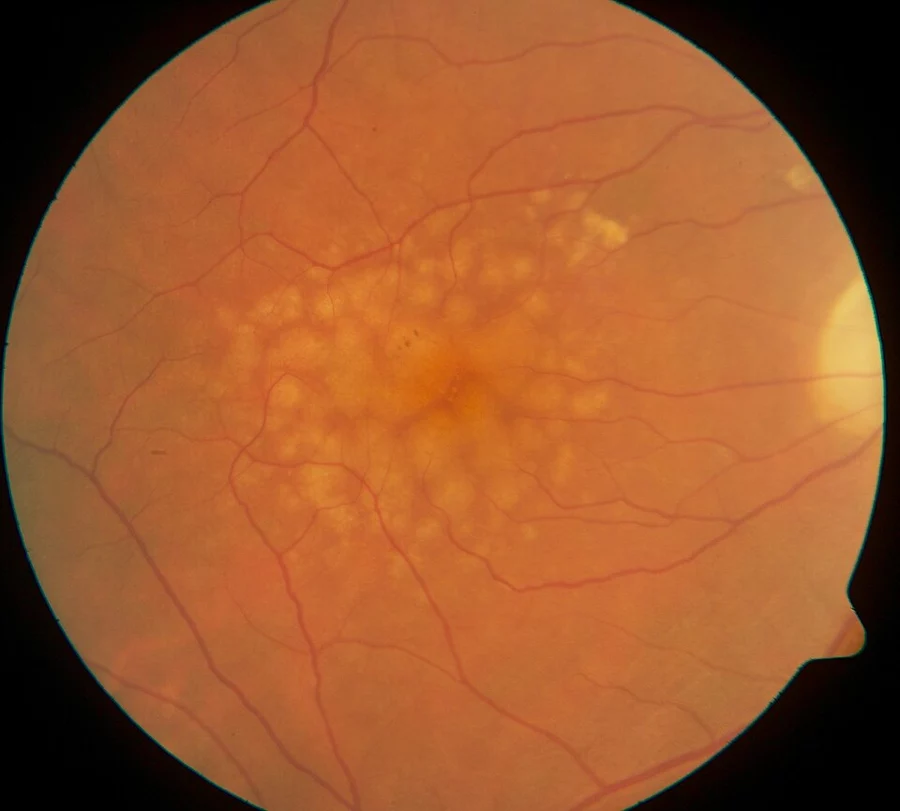
You can’t see drusen while looking in a mirror. But an ophthalmologist (an eye care specialist) may detect them during an eye examination. Your eye doctor may take pictures of drusen using optical coherence tomography (OCT) — a scan that creates detailed images of the retina — or a retinal camera.
Drusen may be the first sign that a person has dry AMD. In some cases, dry AMD may progress to wet AMD.
Both wet and dry AMD can affect your vision. But wet AMD is linked to more severe and rapid vision loss than dry AMD. For that reason, prompt treatment of wet AMD is very important.
As dry AMD progresses, drusen may get bigger and you may have more of them. Larger or more numerous drusen can signal a higher risk of AMD progression and vision loss. That’s why doctors recommend regular eye exams to monitor AMD progression and check the status of drusen.
Currently, there’s no proven way to make drusen disappear. Even if drusen shrink or go away, this doesn’t necessarily mean that AMD has improved or that lost vision will return.
In rare case reports involving only one person each, drusen have decreased or disappeared, but scientists don’t know whether the reported procedures or treatments caused these changes.
In one case report, an 83-year-old woman with AMD had surgery to treat a detached retina. Within two months after the retinal detachment surgery, her drusen had disappeared.
In another case, a 73-year-old man with dry AMD used photobiomodulation, a type of light therapy. After using the photobiomodulation device at home for eight months, his drusen dramatically improved.
In a third case study, a 64-year-old woman had wet AMD in one eye and dry AMD in the other eye. During a follow-up visit, her doctors noted a dramatic drusen improvement in the eye with dry AMD. She had recently undergone cataract surgery and was diligent about taking daily supplements, but her doctors couldn’t say for sure what caused her drusen to improve.
These case reports show that drusen can sometimes shrink or disappear, but this is uncommon and unpredictable. Current AMD treatments focus on slowing disease progression or treating specific complications — not removing drusen or preventing all new drusen from forming.
There’s no treatment for drusen specifically. And while macular degeneration can’t currently be reversed, some treatments may slow its progression or reduce vision loss, depending on the type and stage of AMD. These therapies won’t remove your drusen, but they may help preserve your vision or slow further damage.
Current treatments for dry AMD and geographic atrophy (an advanced form of dry AMD) include:
In addition to medical treatments, your doctor may recommend lifestyle changes to help you manage AMD. These could include:
Your eye care team may recommend that you monitor your dry AMD at home in between eye exams. One option they may suggest involves using an Amsler grid.
While looking at the grid one eye at a time, note whether any lines look wavy, blurry, distorted, or missing. The grid can help you notice new vision changes, but it can’t confirm whether AMD has progressed. Contact your eye doctor promptly if you notice a new change.
“Get an Amsler grid to keep a check on any new symptoms and if you notice any, get in right away to your retina doctor,” one myAMDteam member said.
Another added, “I don’t see wavy lines or distortions on the Amsler grid, but I do have trouble seeing well in dim light.”
Brighter lighting and higher contrast may make daily activities easier for people with AMD. Some people also find visual aids, such as screen readers and magnifying glasses, helpful.
Researchers are exploring several new treatments for dry AMD that may slow disease progression or protect retinal cells.
For instance, with gene therapy, doctors replace faulty genes with healthy ones to help stabilize or improve vision. Stem cell treatments are another possibility. These therapies may help replace damaged tissue with healthy tissue to improve AMD.
While these treatment advances are still being studied, they may eventually offer more options for people living with AMD.
It’s important to share your concerns about drusen with your care team. Your ophthalmologist can help you decide which treatment options may help you slow AMD progression.
If you’re interested in trying an emerging therapy, ask your retinal specialist about whether any clinical trials are available near you. They can assess whether you may qualify for a study and explain the possible benefits, risks, and time commitments.
On myAMDteam, people share their experiences with age-related macular degeneration, get advice, and find support from others who understand.
Have you noticed new or growing drusen in your eyes? Let others know in the comments below.
Get updates directly to your inbox.


Is preservation Areds 3 better than 2


 Continue with Facebook
Continue with Email
Continue with Facebook
Continue with Email
Continue with Facebook
Continue with Email
Continue with Facebook
Continue with Email
Become a member to get even more





 Join
Join


 Your Privacy Choices

This is a member-feature!
Sign up for free to view article comments.
MyAMD is primarily a marketing company. Their recommendation for Valeda Light treatment where only a 100 pts were tested. I am sad to see this promoted here as something that is mainstream.
We'd love to hear from you! Please share your name and email to post and read comments.
You'll also get the latest articles directly to your inbox.